Friday, 17 February 2012

Traditional Housing & Longhouses :: Sabah & Brunei, Borneo

It's been a busy month with travelling around Sabah, Borneo then a quick trip to the UK for my sister-in-law's wedding - and now I am on a week stopover in Dubai before continuing on our travels to the Philippines.


Travelling around Borneo was great fun and interesting to see other house styles in this tropical climate. There is a actually bit of a mix between timber stilt housing (similar to the Australian Queenslanders), new terraced and townhouse developments and traditional and new community 'Longhouses'. 

A traditional 'Longhouse' literally means a large wooden communal structure, raised on stilts (in the case of the modern ones there is parking beneath) and the home and communal dwelling to one indigenous community or extended family.

In Northern Sabah there still remains the traditional timber Longhouses, this one belongs to the Rungus community and was originally 90 doors long with each dwelling being 3 meters in width, making a 270m longhouse! 

A traditional timber longhouse
The timber and bamboo construction allows for shade all day long in the private family rooms and the communal covered area.
Massive open plan communal living areas with open wall construction to allow for cooler air flow
It is designed with slanted side walls to allow the occupants to sit comfortably without the need for modern furniture! This is quite important as the Rungus women are renown for their skills as bead weavers and sit with their legs stretched out in order to produce their handicrafts.
Slated walls for leaning against, sleeping areas and all with minimal furniture
I was also invited to a more modern Longhouse in Brunei which was similar in layout but constructed in modern materials and with car parking spaces below.
Some communal furniture
Room below for car parking
Nowadays communities favour the modern town housing developments which are still similar in layout to the traditional longhouse community, thus still allowing for extended family living.

I wonder how we would all fair if we all lived so close to our extended families? 

Have fun.

Tuesday, 31 January 2012

Fabrics of India :: Indian Sari Fabric


On my last few days in India I had the pleasure of shopping for silk sari material to send back to Australia. 

Inspired by this wall hanging from a restaurant called Dal Roti in Fort Kochi that had been created from hand loomed cotton sari material, I was looking to source some fabric that can be used to make artwork for a rather large white wall I have at home. 
Artwork from Dal Roti (Left Image)
Sari material would be perfect for the job as each piece is about 5 metres in length and can come with different patterns printed within the one piece. Each piece of the artwork can then be created from different parts of the same fabric used to make up a complete sari.

Shopping for the sari material is quite an experience! First you are asked what price range you want to choose from and are then seated at the appropriate place along a long wide table that weaves it way around the shop in front of the hundreds of shelves full of amazing material. After explaining the colours and styles you are looking for the sales staff bring you a range of 5m long folded silk saris to choose between. As they extravagantly unfurl each sari it soon becomes clear why you need such a long table to see the complete design!
Shopping and fabric overload!

In my case I was looking for fabric that I can hang on the wall and had to ask the staff to hold these impressive 5m long pieces of fabric high up so that I could see what it would look like. This selection alone needed three people to hold it up!

After what seemed like many hours I had to rationalise my selection to just a few saris and walk away from the many beautiful designs that remained.
My final fabric selections
The fabrics have now been sent back home and I just cannot wait to get back in May to take another peak and start transforming them into artwork.

Have fun.

Sunday, 22 January 2012

Modern Art Deco :: Trinity, Malabar house, Fort Cochin, Kerala

This beautiful home dates back to 1740 and was the headquarters of the Dutch East India Company here in Kochi, Kerala.

What caught my eye with this lovely property was the architectural style, original reclaimed features and bold use of colour used to create these colonial styled villas built around private courtyards. 
Each villa has it's own indoor-outdoor bathroom next to a courtyard with an outdoor shower that uses a large metal bowl set into pebbles for it's base.
There is also a vast range of eye-catching artwork and sculptures arranged around the house and a beautiful collection of Art Deco furniture interspersed with modern furniture.
The terracotta ceiling tiles
Eye-catching artwork and sculptures
The entrance and building style
With this style of modern architecture along with the use of original features like the original terracotta tiles within the vaulted ceilings, there is a strong sense of history and character that you would struggle to achieve with a regular plasterboard ceiling and rendered walls!

Have fun.


Tuesday, 17 January 2012

Handbuilt Eco Cottages :: The Bohemian Masala, Varkala, India


A few weeks back I stumbled across The Bohemian Masala, a slightly different approach to an eco resort tucked away behind the main tourist strip in Varkala, Kerala. 

The resort contained a number of curious, indigenous hand built mud eco cottages. 
Each cottage has been designed on plan for maximum airflow and constructed with handmade mud bricks. The walls were then plastered using a traditional method of applying clay rich mud and cow dung and then painted with natural pigments such as red brick dust, flowers and herbs.

The pigment for the black floors is carbon from burnt coconut husks that has been given a top coat of wax to seal the floors. The thick brick walls, use of small windows and traditional plaster create a surprisingly cool room.
Also, a mix of secondhand ceramic tiles and palm leaves have been used to construct the roofs. All the timber used is sourced from ex plantation stock coconut trees.
For the interiors all the furniture is handmade with local ex plantation stock timber from a mixture of coconut and jack fruit trees. 
All the fabrics for the ceilings, curtains and wall coverings have been made from secondhand sari material.


What a great way to use up all those old sari's.


Have fun.


Wednesday, 4 January 2012

Chic Colonial Indian Design style :: The Raheem Residency, Kerala, India

This beautiful heritage residence caught my eye last year when I was looking for interesting places to stay in Kerala over the Christmas and New Year period. 
You really feel that you are in your own private palace!
Originally built by an Englishman in 1868, this beautiful house was purchased in the 19th century by Mr Raheem who moved his family from the Indian state of Gujarat to the thriving port town of Alleppey.

In 2003 the home was purchased by it's current owners who undertook the process of converting the run down home into a chic boutique hotel whilst retaining and restoring its original classical colonial Indian style. The new hotel was re-named the Raheem Residency. 

With ornate antique timber furniture and interesting objet d'art scattered around, this boutique home has an amazing mix of traditional Indian colonial elegance and a quirky chic style set in a lovely heritage residence. 
Such amazing carved timber detailing and unusual pieces of artwork... 
Now this is what you call a four poster bed Indian style!
Images courtesy of The Raheem Residency
Now this is truly a chic colonial heritage hotel and I am so glad I had the opportunity to visit such an amazing place.

Happy New Year.

Sunday, 1 January 2012

Interior Designer Brisbane

ABOUT NATURAL MODERN INTERIORS

Natural Modern Interiors is Lisa Coulburn’s blog about natural modern design, interiors, eco homes, eclectic rooms and beautiful things I find on my travels and as a collection of interior design ideas to promote the use of natural furniture, materials and methods to renovate, decorate and style your home.

ABOUT ME
My name is Lisa Coulburn. Together with my husband I live in our renovated post war cottage in sunny Brisbane, Queensland, Australia.

I am a professional Interior Designer with an addiction to spa retreats, a passion for travel and creating interiors inspired by natural materials and exotic places. Originally from England, my work and travels have taken me from London to Europe, South America, Asia and now here in Australia.

I am also the owner of ifdesign interior designers based in Brisbane. I started ifdesign for those who seek a unique and naturally inspired interior design approach with a global perspective.

ABOUT MY DESIGN PHILOSOPHY
I believe that your home should be your retreat – a place to escape to that reflects your lifestyle, personality and individuality. How you renovate or decorate your home can have a big influence on how you feel when you are relaxing, entertaining or working from home.

My own style is natural modern design with an eclectic twist and a strong connection to the outdoors.

While I am sourcing products, materials and creating designs for my clients I also support the following principles:

Reduce, reuse, recycle
This involves taking unloved furniture and waste materials and transforming them into new furniture or new uses. Why? This reduces the need for consuming new raw materials thus reducing energy use, landfill and lowering greenhouse gas emissions.

Low VOC’s & non-toxic materials
Materials such as paints, stains, varnishes, carpets, new furniture and kitchen joinery can off-gas producing poor air quality in your home. This can continue for years after the products and materials are initially installed. By selecting products that are non-toxic and low or no VOC you are improving the quality of your air within your home and reducing the effects of poor air quality on your health. Learn more about air quality & Volatile Organic Compounds (VOCs).

Made in Australia
By buying furniture and homewares made in Australia you are supporting local Australian communities, maintaining creative skills and local craftsmanship and reducing energy consumption and green house gas emissions by avoiding overseas transportation.

Fair trade
Is the term given to a movement to promote a better financial relationship between producers, sellers and consumers. By buying Fairtrade products you area supporting farmers, their families and communities in receiving more stable and secure incomes and better working conditions.


Thank you for your interest in Natural Modern Interiors. I do enjoy reading all your messages so feel free to write me with any questions, comments, suggestions and story ideas. You can visit my contact page to send me an email.

I look forward to hearing from you.

Tuesday, 20 December 2011

Coastal Decoration Indian Style :: Goa, India

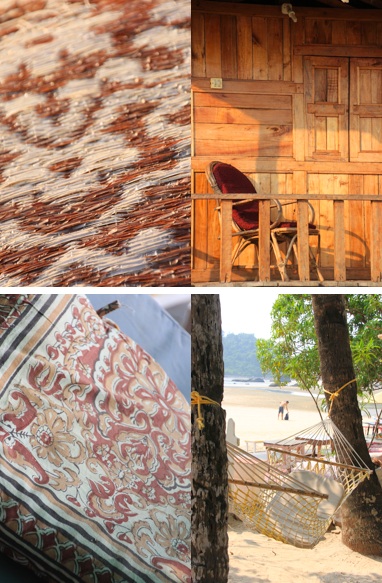
I am always drawn to the colour and texture when I walk along a beach and it's a pleasant surprise to find so much inspiration on Indian beaches...
These beach huts at Cozy Nook use decorative timber screens as the downstairs entrance wall and look stunning against a the natural bamboo backdrop. 

In contrast these images are of fishing nets, timber panelling, ceramic pots, fabrics and other objects that have now found a new uses. 

Next stop the beaches of Kerala.

Have a Merry Christmas and a Happy New Year.